
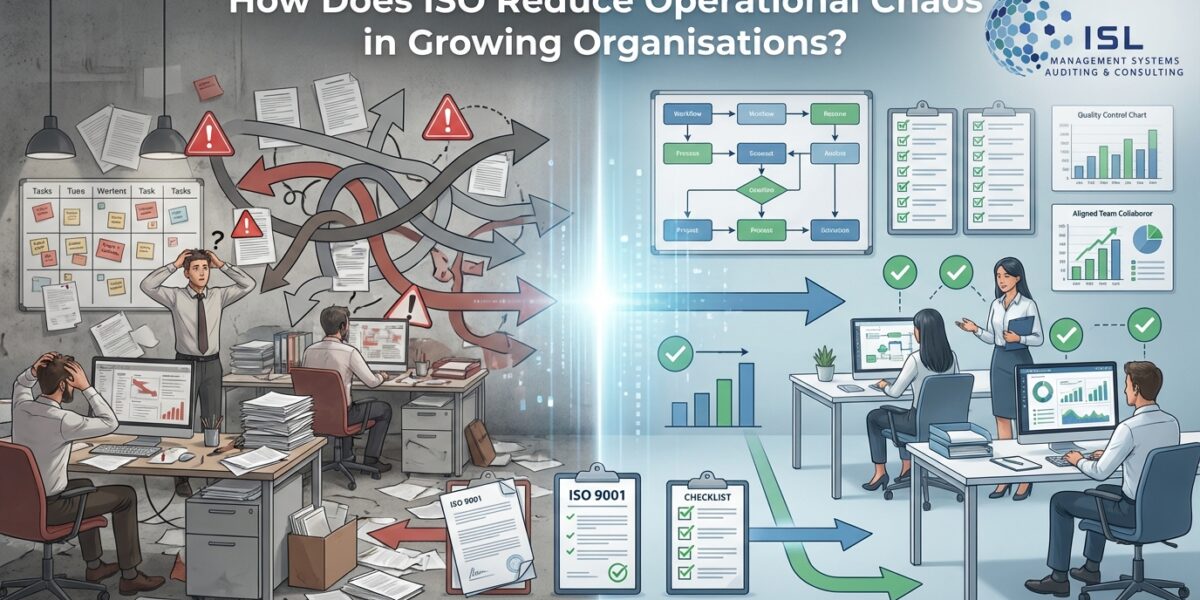
Operational chaos doesn’t happen overnight. It grows slowly and quietly through undocumented processes, inconsistent decisions, unclear responsibilities, and reactive management styles. Many growing businesses accept this chaos as “normal” because it develops gradually as the organisation grows.
Over time, however, this lack of structure begins to affect productivity, customer satisfaction, employee morale, and leadership confidence.
ISO was created to fix this exact problem by introducing structured ISO systems that bring clarity and control to daily operations.
How Operational Chaos Looks in Real Life
Chaos isn’t always a loud explosion; usually, it’s just the quiet background noise of your business. It becomes part of the furniture, and before you know it, nobody is even questioning the inefficiencies anymore.
Some common signs include:
- The inconsistency problem. You’ll see different teams handling the same exact job using whatever methods they’ve come up with, which leads to a total lack of consistency across the board.
- Repetitive rework that forces you to spend a significant portion of the work week fixing errors that should have been caught the first time.
- Outdated or non-existent documentation, specifically manuals that haven’t been updated in years and no longer reflect how the business operates.
- Unpredictable service quality that results in one customer receiving an excellent experience while another receives something subpar.
- Urgency-based decision-making where major moves are triggered by immediate pressure or the “loudest” problem rather than actual operational data.
These issues might feel like minor growing pains at first, but the second you try to scale, those small cracks turn into significant operational gaps. Productivity inevitably dips, accountability becomes difficult to track, and that is usually exactly when your customers begin to notice the slip in standards.
If not addressed, operational chaos can stop long-term growth—especially for SMEs operating in competitive African markets.
How ISO Brings Control Without Being Strict
Many people believe that ISO reduces flexibility. In reality, ISO does the opposite. It provides organisations with a framework while still allowing them to adapt and improve.
ISO establishes ISO process control to ensure that activities are:
- Clearly defined
- Consistently followed
- Measurable
- Continuously improved
Instead of relying on individual memories or experiences, organisations work through defined systems. This shift reduces dependency on individuals and improves operational stability.
This move is why many organisations turn to ISO consulting services in Africa to implement ISO in a practical, business-friendly way.
How ISO Systems Clear Up Confusion
Structured ISO systems help organisations understand what’s happening at every level of their operations. Processes are no longer informal or assumed; they are documented, communicated, and understood.
Instead of guessing, ISO helps you put actual structure around the work. It’s about getting everyone on the same page with visible workflows they can actually follow while pinning down who handles what so there’s no more guessing about who’s responsible for a task.
It also forces you to actually document those SOPs (Standard Operating Procedures) instead of just keeping them in people’s heads. That way, you can layer in performance monitoring to catch small mistakes before they turn into full-blown crises.
We usually build these systems through practical management systems consulting, mostly because it keeps everything grounded in how your business actually functions day-to-day, instead of just following some abstract theory.
Why ISO Is Important for Small and Medium-Sized Businesses in Africa
For small and medium-sized businesses, growth often happens faster than internal systems can adapt. New employees are hired, new clients are onboarded, and operations are expanding, but processes remain informal.
ISO for SMEs in Africa provides a way to grow without an operational breakdown.
By implementing ISO, organisations can:
- Scale operations in a controlled and manageable way.
- Reduce business and compliance risks.
- Improve leadership visibility and decision-making.
- Establish discipline across teams and locations.
Working with experienced ISO consultants ensures that ISO systems support growth instead of slowing it down.
From Firefighting to Proactive Management
Without structured systems, organisations primarily focus on reacting to problems. Organisations only address issues when they become urgent or disruptive.
ISO changes this approach.
With ISO in place:
- Monitoring helps identify issues early.
- Risks are addressed before they escalate.
- Improvements are planned and prioritised.
- Management decisions are based on data rather than assumptions.
This shift from firefighting to proactive management is one of the strongest benefits of ISO implementation.
How ISO Consulting Supports Long-Term Success
The success of ISO hinges on the effective implementation of its clearly defined requirements. Poor implementation often results in documentation-heavy systems that do not support daily operations.
Professional ISO consulting ensures that systems are:
- Practical and easy to follow.
- Scalable as the organisation grows.
- Embedded into everyday business activities
If your organisation is ready to reduce operational chaos and build structured systems, it is important to contact our ISO specialists for guidance.
How ISO Reduces Chaos by Creating Discipline
ISO is not about control for its own sake. It is about clarity, consistency, and confidence.
When implemented correctly, ISO becomes the foundation for the following:
- Reliable operations
- Better decision-making
- Stronger accountability
- Long-term organisational growth
ISO reduces operational chaos by replacing uncertainty with structure and reaction with discipline. For growing organisations, ISO is not just a compliance requirement; it is a strategic advantage.
Conclusion: From Chaos to Control
Operational chaos may seem manageable in the early stages of growth, but over time it limits performance, weakens accountability, and slows progress. Sustainable growth requires more than effort — it requires structure.
ISO provides that structure by introducing clear processes, measurable performance, and disciplined management practices. It replaces uncertainty with control and reactive decision-making with strategic direction.
For growing organisations, ISO is not just about certification; it is about building a stable foundation for long-term success.
If your organisation is ready to reduce operational chaos and implement practical, business-focused ISO systems, contact our ISO experts to begin your structured growth journey.