
A production manager at a food-packaging plant in Nairobi’s Industrial Area pulled out the SOP binder during a client audit and realised the version on the shelf hadn’t matched what was happening on the floor for at least eight months. The document said the metal detector calibration check ran every shift. The floor supervisor said it ran when someone remembered. That gap is what most SOP consulting for manufacturing work actually exists to close, and it’s rarely about writing new documents from scratch. It’s about finding out which of the old ones nobody has followed in months.
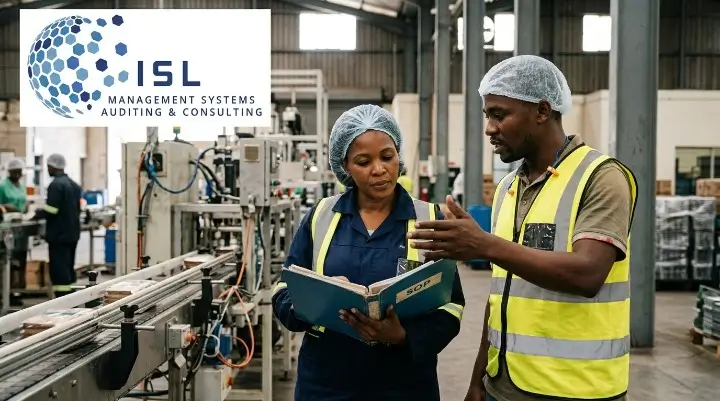
Why manufacturing SOPs fail even when they exist
Most manufacturing sites across Kenya and East Africa aren’t short of documentation. Walk into any mid-sized production facility and there’s usually a folder, sometimes several, covering everything from raw material intake to finished goods dispatch. The problem isn’t absence. It’s that the procedures were written once, often years ago, by someone who has since left the business, for a production line that has since changed. Operators work around the paperwork because following it exactly would mean stopping the line to do something the process no longer requires.
What SOP development consultancy actually involves on the floor
A proper SOP development consultancy engagement doesn’t start with a template. It starts on the floor, watching a shift run start to finish and comparing what actually happens against what the existing document claims happens. Where the two match, the SOP stays. Where they don’t, someone has to decide whether the floor practice is correct and the document is outdated, or whether the floor has drifted from a step that matters for safety or quality. That call needs someone who understands both the standard being worked towards and the practical reality of a production environment, not just someone who can format a Word document.
The difference between the two approaches is easier to see side by side:
| What you look at | Template-based SOP writing | Floor-based SOP development |
|---|---|---|
| Starting point | A generic template with your company name added | A full shift observed from start to finish |
| Who gives input | Management and the quality office | Operators, supervisors and the person accountable for quality |
| Language | Office English, accurate on paper | Wording an operator can follow on a night shift |
| Responsibility | Often left unstated | A named person for every checked step |
| Records | Optional forms added at the end | A dated record tied to each step |
| Audit result | Document, operator answer and record often disagree | All three line up when the auditor checks |
| Six months later | Back on the shelf | Still in use, because the floor helped write it |
Where the documentation usually goes wrong
Two patterns show up constantly. The first is SOPs written in language that reads well in an office but means little to an operator on a night shift, for whom English may be a third language. A procedure has to be followable under those exact conditions, not just accurate on paper. The second is SOPs that specify a step without specifying who checks it happened. A calibration procedure without a named responsible person and a dated record is a procedure that will quietly stop being followed within a few months, however well it was written.
Here is what the fix looks like for the metal detector step from the opening story:
Before: Calibrate the metal detector regularly.
After: The shift supervisor runs the test pieces through the metal detector before the line starts and signs the calibration log with the time. If a test piece is missed, the line does not start until the quality officer has cleared it.
The second version says who does it, when, and what proves it happened. That is all an auditor, or the next supervisor, needs to see.
The ISO 9001 connection manufacturers can’t avoid
For manufacturers working towards ISO 9001, whether for a specific client requirement or wider market access, the SOPs are the backbone of the quality management system. An auditor won’t just read the document, they’ll ask an operator to explain the step, then check the record that proves it happened last week. If the SOP, the operator’s answer, and the record don’t line up, that’s a nonconformity, not just an awkward moment during the audit walk-through.
ISO 9001 is rarely the only standard on a factory’s list. A food plant like the one in our opening example will also be asked about food safety schemes such as ISO 22000, FSSC 22000 or HACCP, and many sites add ISO 45001 for occupational health and safety. The SOPs behind each of these overlap heavily. Writing them once, properly, as part of one management system saves a lot of duplicated paperwork later.

Getting operators to actually follow what’s written
None of this holds up if new documentation lands on the floor without buy-in. The SOPs that stick are the ones built with input from the people running the line, not handed down finished. A supervisor who helped write the calibration step is far more likely to enforce it than one reading it for the first time during an audit walk-through, which is where structured training and capacity-building work matters as much as the paperwork itself.
How a floor-based SOP engagement usually runs
- Walk the floor. Watch full shifts, including nights, and note where practice and paperwork part ways.
- Sort the gaps. For each one, decide whether the document is outdated or the floor has drifted from a step that matters.
- Rewrite with the people who run the line. Short steps, plain wording, a named owner and a record for each check.
- Train on the new version. Supervisors first, then operators, on the line rather than in a meeting room.
- Check again. Come back after a few weeks and compare the records with what is happening on the floor.
Sometimes the walk shows that the process itself has changed so much that no SOP can describe it cleanly. In that case the fix starts with the process, and business process reengineering comes before the rewrite.
Talk to ISL About SOP Consulting for Manufacturing
If your production documentation and your production floor have quietly drifted apart, that’s worth finding out before an auditor does. Get in touch with ISL for a straightforward, on-the-floor look at where your manufacturing SOPs actually stand. You can also see the full list of ISL services.
FAQ Section
What does SOP consulting for manufacturing actually deliver?
A set of procedures that match what actually happens on your production floor, checked against the relevant standard, with named responsibility and records for each step, not a generic template with your company name inserted.
How long does it take to develop SOPs for a production facility?
It depends on the number of production lines and how far current practice has drifted from existing documentation, but a proper floor-based review and rewrite typically runs into several weeks rather than days.
Do SOPs need to be rewritten for ISO 9001 certification?
Usually yes, at least in part. Certification requires documented procedures that an auditor can verify against operator practice and records, and most existing manufacturing SOPs weren’t written with that scrutiny in mind.
Who should be involved in writing manufacturing SOPs?
The operators and supervisors who run the process day to day, alongside whoever is accountable for quality. Procedures written without floor input tend to be the ones nobody follows six months later.
What is the difference between an SOP and a work instruction?
An SOP covers a whole process: what happens, who is responsible and what record is kept. A work instruction goes deeper on one task, step by step, for the person doing it. Most plants need both, and they should point to each other.
How often should manufacturing SOPs be reviewed?
At least once a year, and any time the line, equipment, product or a customer requirement changes. A nonconformity found in an audit is also a reason to review the SOP behind it straight away.