
Why business consulting for ISO standards often ends in one integrated system
Many businesses collect ISO standards one at a time. Each new certificate brings a new manual, a new round of audits and another set of people asking for the same records. After a while the management system starts to feel like three separate jobs.
An integrated management system puts those standards into one system. Business consulting for ISO standards is often the quickest route there, because a consultant can look across the standards together instead of through one at a time.

Why the standards fit together
ISO 9001 for quality, ISO 14001 for the environment and ISO 45001 for occupational health and safety share a common structure. Each asks you to understand your business context, set a policy and objectives, plan for risk, control your operations, check your performance and keep improving.
That shared skeleton is what makes integration possible. The requirements underneath differ, but the way the system is built and run is very similar.
What overlaps and what stays separate
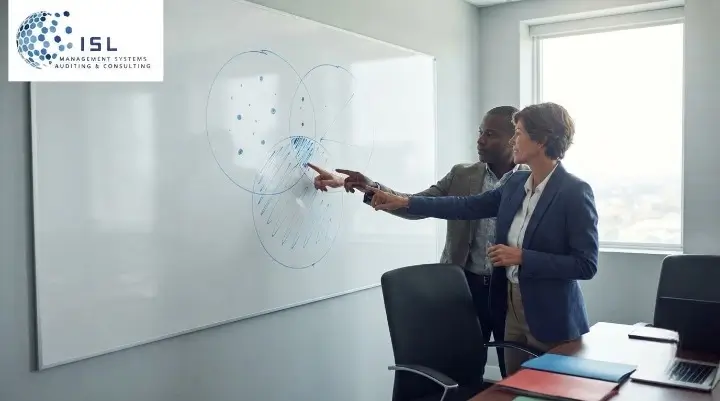
A lot of the machinery can be shared. You need only one of each of the following:
- a document control process
- an internal audit programme
- a management review meeting
- a corrective action process
- a training and competence record
Other parts stay separate because the subject matter is different. Quality needs customer requirements and product checks. Environmental management needs a list of your environmental impacts and legal obligations. Health and safety needs hazard identification and risk controls. Integration does not blur these. It simply stops you building the shared parts three times.
What one system does for you
ISL’s management systems consulting is built around embedding ISO requirements into wider operations and governance. The point is that compliance strengthens efficiency and risk management instead of sitting apart as a separate exercise.
In day to day terms, you hold fewer duplicated documents. Auditors and managers see one programme instead of three. Staff learn one way of working. Senior managers get a single picture of quality, environmental and safety performance, which makes decisions easier.
| Area | Separate systems | Integrated system |
|---|---|---|
| Documents | A separate set for each standard | Shared documents, with topic specific additions |
| Internal audits | One programme per standard | One combined programme |
| Management review | Several meetings covering similar ground | One meeting covering all standards |
| Staff training | Repeated for each standard | One way of working to learn |
| Overall effort | Duplicated for every new standard | Grows less with each standard added |
Where SOPs fit
Procedures are the practical layer of an integrated system. One well written SOP can carry a quality check, a safety step and an environmental control in the same task. Think of a chemical handling routine, where getting the mix right, wearing the right protection and disposing of waste correctly all belong in the same set of instructions. Our article on SOP development consultancy explains how those procedures are built.
Adding more standards later
If the foundation is integrated, the next standard costs less effort. Adding ISO/IEC 27001 for information security or ISO 22301 for business continuity mostly means adding the topic specific requirements, since the shared machinery already runs. For the thinking behind this, read risk and resilience and resilience by design.
How a consultant helps
ISL’s ISO certification facilitation includes a gap analysis, structured documentation support, internal audit guidance, corrective action review and audit preparation. For an integrated system we run those across the standards together, so you are not repeating the exercise for each one. We also train your staff so that the system belongs to your team and not to us.
Is integration right for you?
Not always. If you plan to pursue one standard only, a single standard system is simpler. Even then, it is worth designing it so another standard can be added later without starting over. If you want help deciding, talk to our team.
Talk to ISL about business consulting for ISO standards
If you hold one ISO standard and plan to add more, it pays to design the system for that from the start. ISL’s business consulting for ISO standards covers gap analysis, documentation support and audit preparation across standards. See our consulting services or call +254 794 66 99 60.